May 1, 2026
Summer in the Mid-South tends to send people to the same places: the beaches, the mountains, the cities with the big-name attractions. This is an argument for the other option.
The Blues Backroads route runs through some of the most underestimated landscape in the country, connecting small towns across West Tennessee and into neighboring corners of Mississippi and Arkansas. These are the towns that shaped American music, that fed the people who built the Delta, that carry histories most textbooks skimmed over. They are also, in the practical sense, some of the best places in the region to spend a summer day.
Here are five reasons to make Blues Backroads your summer road trip destination this year.
There is no polite way to say this: the food along the Blues Backroads route is better than it has any right to be given how little anyone talks about it.
West Tennessee barbecue. Delta tamales. Catfish that was in the river more recently than it was on your plate. Meat-and-three lunch spots where the vegetables are cooked the way vegetables were cooked before everyone decided they should be raw. Pie sold by the slice out of glass cases by people who made it this morning.
The culinary tradition of this corridor is a direct product of its history: the intersection of African American food culture, Southern agricultural life, and the specific geography of the Mississippi River Valley. The dishes that come out of that tradition are distinct, specific, and not available anywhere else, because they came from this place and they are still being made here by the people whose grandmothers invented them.
None of this requires a reservation. Most of it requires no planning at all beyond showing up hungry.
There is a version of American history that gets told in the big museums in the big cities, and then there is the version that is still visible in the places where it actually occurred. Blues Backroads runs through the second kind.
Fort Pillow, on the bluffs above the Mississippi in Lauderdale County, was the site of one of the most significant and painful events of the Civil War. The courthouse squares in Somerville, Covington, and Halls have been the center of civic life in their counties for nearly two centuries. The crossroads and small towns throughout this route are places where the blues was born, not as a genre but as a way of processing real experience in real communities under real pressure.
Coming to these places is not a history lesson. It is something more like a correction, a reminder that the most important American stories were not all told in cities, and that the people and places that made them are still here.
A summer weekend on Blues Backroads costs a fraction of what a comparable trip to a coastal destination or a resort town would cost, and it does not feel like a compromise.
State park camping at Fort Pillow runs a few dollars a night. The food, as previously noted, is excellent and priced for the people who live here. The attractions, from courthouse squares to river bluffs to local festivals, are mostly free. The drive itself is the experience, and gas goes further on Tennessee two-lane roads than it does sitting in beach traffic.
If you have been sitting on the fence about a summer trip because of what things cost this year, Blues Backroads is the practical answer. The value is not the point, but the value is genuinely there.
West Tennessee in summer is a specific visual experience that is worth seeking out rather than driving through.
The fields of Fayette and Tipton counties in June and July are extraordinary, flat and green and stretching to a horizon that exists nowhere in the eastern United States. The light in the late afternoon across this landscape does something that photographers try to describe and generally fail at. The Mississippi River, visible from the bluffs at Fort Pillow or from the bridge at Marion, Arkansas, is one of the great natural spectacles of the continent, and in summer it is wide and brown and moving with a force that makes itself felt.
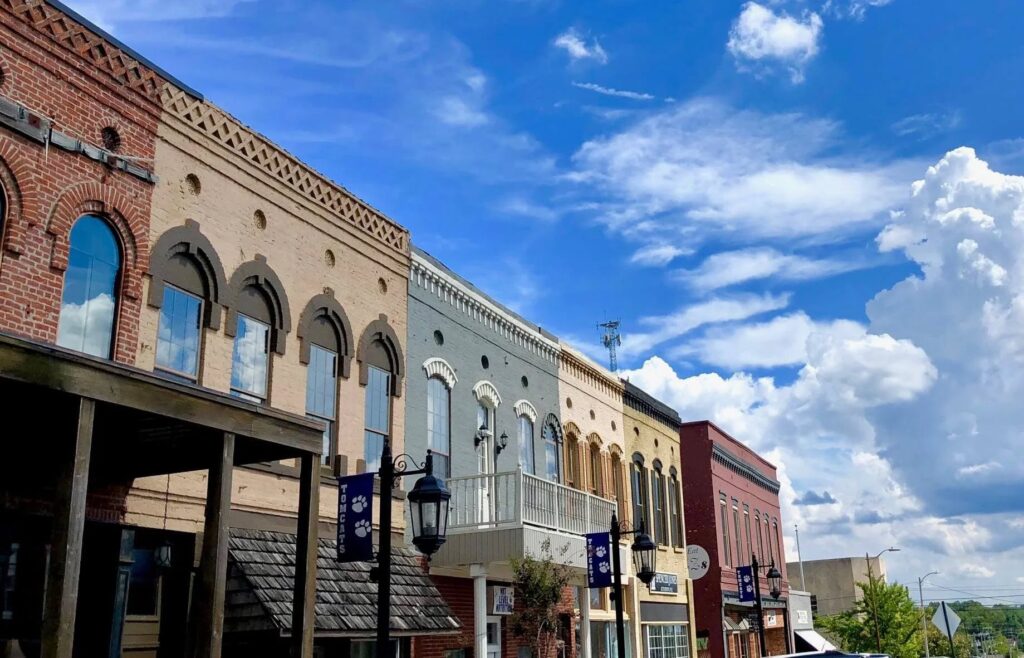
The small towns on the route have their own aesthetics: the courthouse squares with their mature trees and covered sidewalks, the residential neighborhoods with their deep porches built for a time before air conditioning when everyone lived outside from May through September. These are good-looking places, genuinely. Bring a camera.
This one is harder to quantify but easy to verify by going.
The communities along the Blues Backroads route are not tourism towns. They are working towns with economies built around agriculture, local business, and the kind of civic life that happens when people have lived in the same place for generations. When you show up as a visitor, you are showing up as a guest in someone’s actual community, and the experience of that is different from what happens when you visit a place that exists primarily to serve visitors.
People will talk to you. They will tell you things about the town that are not in any brochure. They will recommend the place where they actually eat lunch, not the place the local development organization put in the visitor guide. That kind of genuine local knowledge is not something you can buy on TripAdvisor. You get it by being here, by being curious, and by being willing to have a conversation.
That is the Blues Backroads experience at its best: a series of small, genuine encounters with places and people that are worth knowing. There is no better time to have it than summer.
Follow Blues Backroads on Facebook and Instagram for event updates, local recommendations, and the latest from the route all season long.
Share Backroad Memories